UK ups money laundering risk for remote casinos and slot games in latest 2025 National Risk Assessment, citing crypto, MSBs, and illegal casinos.
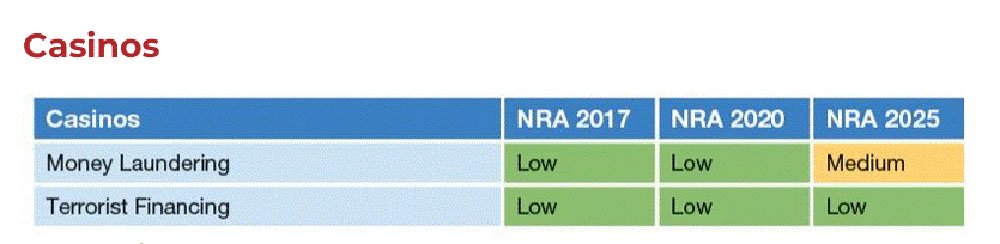
In its 2025 National Risk Assessment (NRA), the UK Treasury has raised the money laundering (ML) and terrorist financing (TF) risk level for the casino sector from low to medium, driven by increasing volumes of remote casino activity, evolving payment methods, and rising engagement with illegal operators. The report builds on the findings of the UK’s third NRA in 2020 and outlines major trends and vulnerabilities identified over the past five years.
The Gambling Act 2005 defines both remote and non-remote casinos under its legal framework. As of 2024, there are 247 licensed casinos in the UK—up from 210 in 2020—with 97 (39%) deemed high-risk by the Gambling Commission. Increased online activity, especially during the Covid-19 lockdown, has driven higher transaction volumes, while the shift to digital gambling formats has introduced new ML vulnerabilities.
The most common laundering method identified remains the recreational spending of criminal funds. However, the Treasury also notes efforts by criminals to actively “clean” illicit money through both licensed and illegal casinos. Notably, illegal operators have expanded their presence in the UK, exploiting gaps in compliance, especially through online channels and cryptoassets.
The sector’s vulnerabilities are tied to high-risk payment methods, including Money Service Business (MSB) activity. Although fewer casinos now offer MSB services, those that do face risks tied to foreign currency exchange, third-party transfers, and money mule activity. High-end land-based casinos continue to serve international customers, including politically exposed persons (PEPs) from high-risk jurisdictions, increasing the potential for exposure to funds from corruption.
Remote casinos’ use of white-label arrangements was flagged again, as failures in due diligence among third-party partners have historically enabled compliance gaps. While such models are now less common, risks remain where partners operate multiple websites without adequate oversight.
Suspicious Activity Reports (SARs) in the sector rose 26% between 2022/23 and 2023/24, from approximately 6,000 to 7,500. This may reflect improvements in industry training, suspicion detection, and SAR reporting practices.
Compliance with Customer Due Diligence (CDD) and Enhanced Due Diligence (EDD) has worsened. In 2024, 12.5% of casinos were non-compliant with CDD (vs. 7% in 2023), and 41% failed to apply EDD on a risk-sensitive basis (vs. 11% in 2023). However, all casinos assessed in 2024 were found to have effective cash handling policies.
Anonymity remains a challenge, especially where high-net-worth individuals use assistants or prepaid cards. Poker stables and staking syndicates also introduce complexity regarding source of funds verification.
MSB-related transactions remain a significant risk vector. In 2023, 13% of casinos offered MSB services, with two-thirds of transactions linked to currency exchange. The report highlights increased third-party transfers into casinos, raising the potential for illicit funds entering the financial system. The UAE Dirham was noted as a frequent inbound currency, but rarely used for outbound transfers.
Remote slot gaming has surged, with revenues increasing by 52% since 2020, from £2.3 billion to £3.6 billion. The higher volume, combined with persistent compliance lapses and non-face-to-face customer relationships, increases ML/TF risk. New stake limits—£5 for adults and £2 for players aged 18-24—were implemented in April and May 2025, respectively, but their impact on ML/TF mitigation remains unclear.
The report also outlines the Government’s crackdown on illegal gambling. In 2024/25, the Gambling Commission issued 1,158 cease-and-desist notices, referred over 118,000 URLs to Google and Bing, and successfully removed more than 81,000 URLs from search engine results. Illegal casinos continue to aggressively market via online channels and increasingly utilize cryptoassets, heightening regulatory concern.