Skip to content
Menu
Menu

Chilean deputies propose letting licensed casinos offer games online

The bill would extend existing authorisations to digital channels and introduce criminal penalties, site blocks and payment suspensions for illegal operators

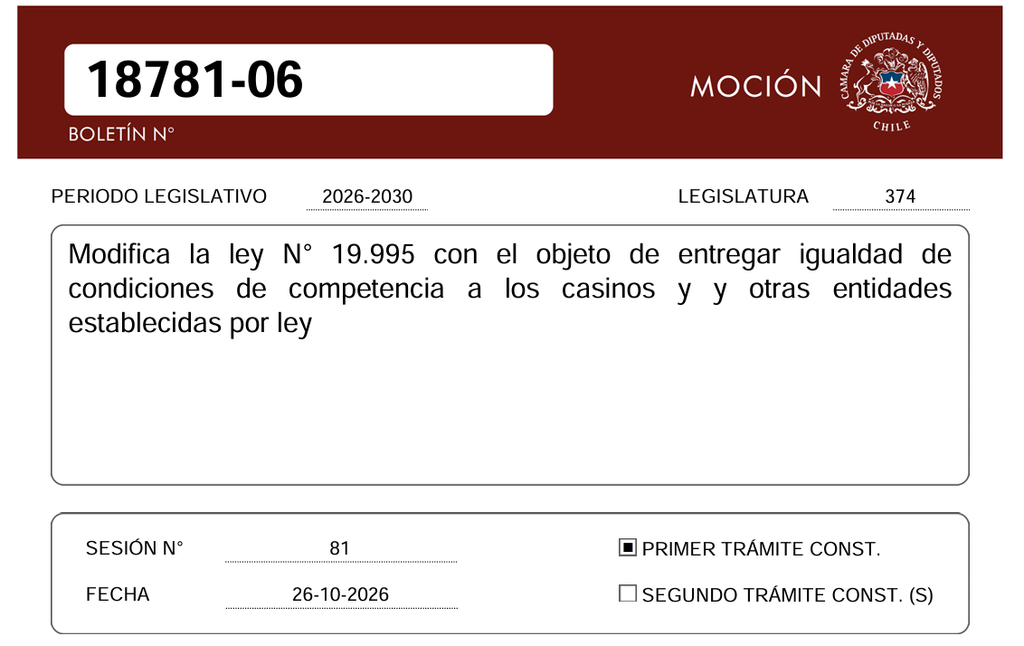
Chilean deputies Sergio Bobadilla, Eduardo Cretton and Cristóbal Martínez have introduced a bill that would let licensed casinos offer their approved games online. The proposal would also allow Polla Chilena de Beneficencia, Lotería de Concepción and authorised racecourses to offer specified products through digital channels. Filed on 22 October as Bulletin 18781-06, the bill remains at its first legislative stage in the Chamber of Deputies.

Digital operations tied to existing permits

The bill would add Article 5 bis to Law No. 19,995. A casino’s authority to offer games online would depend on its physical operating permit and end when that permit expires or is revoked. Each company could operate one platform under a brand and .cl domain notified to the Superintendence of Gaming Casinos (SCJ). Permit holders could hire technology providers to build or maintain a platform but would have to operate the games themselves.
Casinos could begin offering games online only after implementing regulations were published and the SCJ certified their compliance. The online authorisation would neither allow new venues or branches nor extend to gambling aboard vessels governed by separate rules. Using an undeclared domain, handing operations to a third party or seriously breaching identity, payment or self-exclusion requirements could lead to revocation.

The other authorised entities would remain within their existing product categories. Polla Chilena could offer its authorised draws, sports pools and bets through digital channels; Lotería de Concepción could offer its draws online; and official racecourses could accept pari-mutuel horse racing bets electronically. None would gain the right to offer games reserved for licensed casinos.

Identity checks, payments and advertising

Players would have to verify their identity and age and could hold only one account per operator. Deposits and withdrawals would have to use accounts or payment instruments in the player’s name, issued by institutions supervised by Chile’s Financial Market Commission. Cash, anonymous payment methods and credit to finance gambling would be prohibited.

Operators would have to let players set limits on deposits, losses and playing time and offer temporary or indefinite self-exclusion. Lower limits and self-exclusion would take effect immediately; requests to raise limits would take effect only after seven days. Ads could not target minors or portray gambling as a source of income or a solution to financial problems. Operators would also have to keep real-time records available to the SCJ and account for online activity separately.

Penalties for unlicensed operations

Offering online gambling without authorisation would carry proposed prison terms of 541 days to five years and fines of 100 to 1,000 monthly tax units (UTM). The provisions would cover platforms that accept Chilean residents or Chilean-issued payment methods, or advertise to the Chilean public. Those who create or distribute advertising for illegal betting would face fines of 50 to 500 UTM.

Courts could order blocks on websites, domains and apps, suspend payments to unauthorised platforms and extend orders to mirror sites. The bill’s authors acknowledge that these provisions could require a prior opinion from the Supreme Court because they affect judicial powers.

Regional revenue and public beneficiaries

The sponsors argue that unauthorised platforms compete with licensed casinos without bearing the same tax and oversight obligations. Chile had 25 casinos in the figures cited in the motion: 22 authorised under Law No. 19,995 and three operating under municipal concessions. The SCJ reported CLP95.425 billion in taxes accrued by casinos licensed under that law in the first half of 2026, down 8.87% in real terms year on year. The total included CLP41.695 billion in specific gambling tax, split equally between the host municipalities and regional governments.

The bill would apply the existing tax regime to digital operations without subsidies or tax reductions. Its authors argue that giving licensed operators another source of revenue could help protect regional jobs and tourism, as well as the funding Polla Chilena provides to charities and Lotería de Concepción provides to the University of Concepción.

24 November 2026

Subscribe to our newsletter

More
Related Posts

Categories

Chilean deputies propose letting licensed casinos offer games online

The bill would extend existing authorisations to digital channels and introduce criminal penalties, site blocks and payment suspensions for illegal operators

Chilean deputies Sergio Bobadilla, Eduardo Cretton and Cristóbal Martínez have introduced a bill that would let licensed casinos offer their approved games online. The proposal would also allow Polla Chilena de Beneficencia, Lotería de Concepción and authorised racecourses to offer specified products through digital channels. Filed on 22 October as Bulletin 18781-06, the bill remains at its first legislative stage in the Chamber of Deputies.

Digital operations tied to existing permits

The bill would add Article 5 bis to Law No. 19,995. A casino’s authority to offer games online would depend on its physical operating permit and end when that permit expires or is revoked. Each company could operate one platform under a brand and .cl domain notified to the Superintendence of Gaming Casinos (SCJ). Permit holders could hire technology providers to build or maintain a platform but would have to operate the games themselves.

Casinos could begin offering games online only after implementing regulations were published and the SCJ certified their compliance. The online authorisation would neither allow new venues or branches nor extend to gambling aboard vessels governed by separate rules. Using an undeclared domain, handing operations to a third party or seriously breaching identity, payment or self-exclusion requirements could lead to revocation.

The other authorised entities would remain within their existing product categories. Polla Chilena could offer its authorised draws, sports pools and bets through digital channels; Lotería de Concepción could offer its draws online; and official racecourses could accept pari-mutuel horse racing bets electronically. None would gain the right to offer games reserved for licensed casinos.

Identity checks, payments and advertising

Players would have to verify their identity and age and could hold only one account per operator. Deposits and withdrawals would have to use accounts or payment instruments in the player’s name, issued by institutions supervised by Chile’s Financial Market Commission. Cash, anonymous payment methods and credit to finance gambling would be prohibited.

Operators would have to let players set limits on deposits, losses and playing time and offer temporary or indefinite self-exclusion. Lower limits and self-exclusion would take effect immediately; requests to raise limits would take effect only after seven days. Ads could not target minors or portray gambling as a source of income or a solution to financial problems. Operators would also have to keep real-time records available to the SCJ and account for online activity separately.

Penalties for unlicensed operations

Offering online gambling without authorisation would carry proposed prison terms of 541 days to five years and fines of 100 to 1,000 monthly tax units (UTM). The provisions would cover platforms that accept Chilean residents or Chilean-issued payment methods, or advertise to the Chilean public. Those who create or distribute advertising for illegal betting would face fines of 50 to 500 UTM.

Courts could order blocks on websites, domains and apps, suspend payments to unauthorised platforms and extend orders to mirror sites. The bill’s authors acknowledge that these provisions could require a prior opinion from the Supreme Court because they affect judicial powers.

Regional revenue and public beneficiaries

The sponsors argue that unauthorised platforms compete with licensed casinos without bearing the same tax and oversight obligations. Chile had 25 casinos in the figures cited in the motion: 22 authorised under Law No. 19,995 and three operating under municipal concessions. The SCJ reported CLP95.425 billion in taxes accrued by casinos licensed under that law in the first half of 2026, down 8.87% in real terms year on year. The total included CLP41.695 billion in specific gambling tax, split equally between the host municipalities and regional governments.

The bill would apply the existing tax regime to digital operations without subsidies or tax reductions. Its authors argue that giving licensed operators another source of revenue could help protect regional jobs and tourism, as well as the funding Polla Chilena provides to charities and Lotería de Concepción provides to the University of Concepción.

LinkedIn
Share
Youtube
X (Twitter)