More than US$144 million was transferred to sport in 2025 S1 representing an increase of around 17,000% compared to last year
According to data published by Brazil’s Federal Revenue Service at the end of last week, the federal Government has collected around R$ 6.8 billion (US$1.3 billion) from fixed-odds betting companies in 2025. Compared to 2024, the amount represents an increase of around 17,000%, as last year the Government collected R$ 38 million (US$7.1 million), reports, Victor Novais for Press FC.
Brazilian sports received R$773.9 million (US$144 million) transferred by betting operators during the first half of 2025. The figure represents 4.4% of the gross revenues generated by these companies, which together earned R$17.4 billion during the period.
Funds were distributed by the Secretariat of Prizes and Betting (SPA) under the Ministry of Finance, according to data from the Access to Information Law (LAI). The allocations included:
- R$478.9 million to the Ministry of Sports
- R$154.9 million to the National Sports System
- R$47.5 million to the Brazilian Olympic Committee (COB)
- R$28 million to the Brazilian Paralympic Committee (CPB)
- R$15.1 million to the Brazilian Clubs Committee
- R$49 million to other sports entities
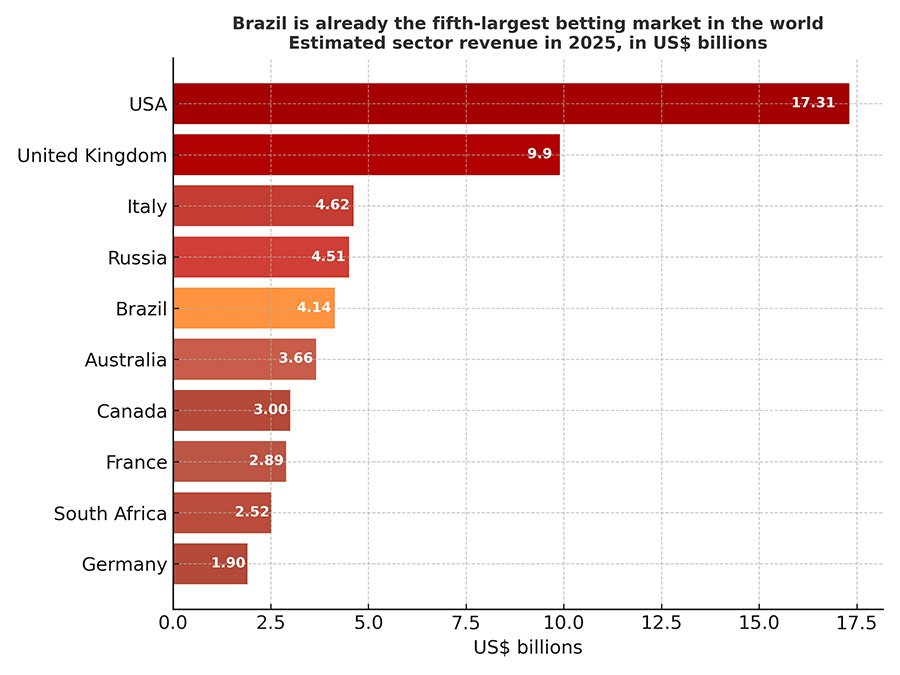
“Since the beginning of sports betting regulations, the sector has positively impacted the country with the generation of thousands of jobs and the transfer of billions of reais in taxes and substantial investments in the sports sector. In addition to direct support to sport, such as the sponsorship of all Serie A clubs of the Brazilian Championship (equivalent to UK’s Football Premier League) , the betting sector contributes more than R$ 700 million to the sport through indirect transfers, which contributes significantly to the development of this field,” says Alex Rose, CEO of InPlaySoft, an international sports betting technology company.
For Marcos Sabiá, CEO of Galeranet, Brazil as the eighth largest economy in the world, and has a historical relationship with gambling, combined with a financial system that has provided fast and secure means of payment, and the arrival of global giants in the sector that already operate in developed and regulated countries, contributing their experience and technology. All this has enabled the establishment of a significant industry in the entertainment field.
“There are three important areas for this developments: electronic payments, technology and marketing, especially advertising and sponsorship in the sports market. Undoubtedly, Brazil’s financial system, which has strong institutions and thriving technology in several transfer payment institutions, in addition to advanced payment methods such as Pix, has led to the flourishing of a healthy and safe market in online gaming,” Sabiá added.
Published in Brazil’s Official Gazette in December 2023 as passed by Congress, the law regulating online sports betting only came into force in January 2025, with a tax rate of 12% on betting companies GGR. However, in June of this year, the Federal Government announced that it would increase the tax to 18%.
However, on Tuesday October 7, the government announced that it retracted the measure, when Federal Rep. Carlos Zarattini, eliminated the measure from his proposal crossing out final text the section stating increase the tax rate on betting companies GGR.
Bernardo Cavalcanti Freire, legal consultant to the National Association of Games and Lotteries (ANJL) and a partner in Betlaw, a law firm specializing in betting, warned about the risks in the tax changes: “Any tax increase on GGR could lead to the destruction of the sports betting sector in Brazil, as it is. A taxation of such level would show a total ignorance of the issue on the part of the Federal Revenue and the Ministry of Finance and would set up a scenario of absolute legal uncertainty, as companies have been established in the country for less than a year.”
In football alone, the country’s main sport, 100% of the clubs competing in Serie A of the Brazilian Championship have sponsorships from authorized betting industry companies. In August, the largest sponsorship contract in the history of Brazilian football was announced, when Betano signed an agreement with Flamengo of about R$ 268 million per year.
Additionally, in 90% of sponsorship in Serie A has been taken by companies in the segment. Apart from Flamengo, other major national football clubs, such as Palmeiras, Corinthians, Santos, and São Paulo, got the biggest commercial deals in their history thanks to sponsorships with sports betting companies.
“Brazilian football has been added more value in recent years, and advertising deals with Santos, Fortaleza, Vitória and Mirassol, with very clear brand features and their passionate fans, has made the investment even more attractive, making the sponsorship, combined with the ad campaigns, enhancing the strength of our brands on the national and international scene,” says Nickolas Ribeiro. partner and founder of the Ana Gaming Group, which ads present in four clubs of the Serie A of the Brazilian Championship: Santos, Mirassol and Vitória, with 7k, and Cassino, with Fortaleza.
Santos FC president, Marcelo Teixeira, highlighted convergent objectives of their association with Ana Gaming: “They have two strong brands that in essence have entertainment as one of their main objectives. 7K came at an important time and with a philosophy of great growth, and their bet on Santos is synonymous with a win-win situation for both.”
The new format of commercial agreements with betting companies goes beyond national borders. Milan, the second-highest winning club in the Champions League, with seven trophies won throughout history, also has a partnership with a sports betting company in Latin America: Reals.
“Being associates with a club as big as Milan is a source of satisfaction and pride for Reals. We have a pioneering and internationally relevant agreement with the Italian team, which contributes to the consolidation of our company as a reference among Bets companies that invest in sponsorships within the sports universe, showing the seriousness and credibility of our work,” concludes Rafael Borges, CEO of Reals, a company that is also a master sponsor of Brazilian FC team Coritiba.